
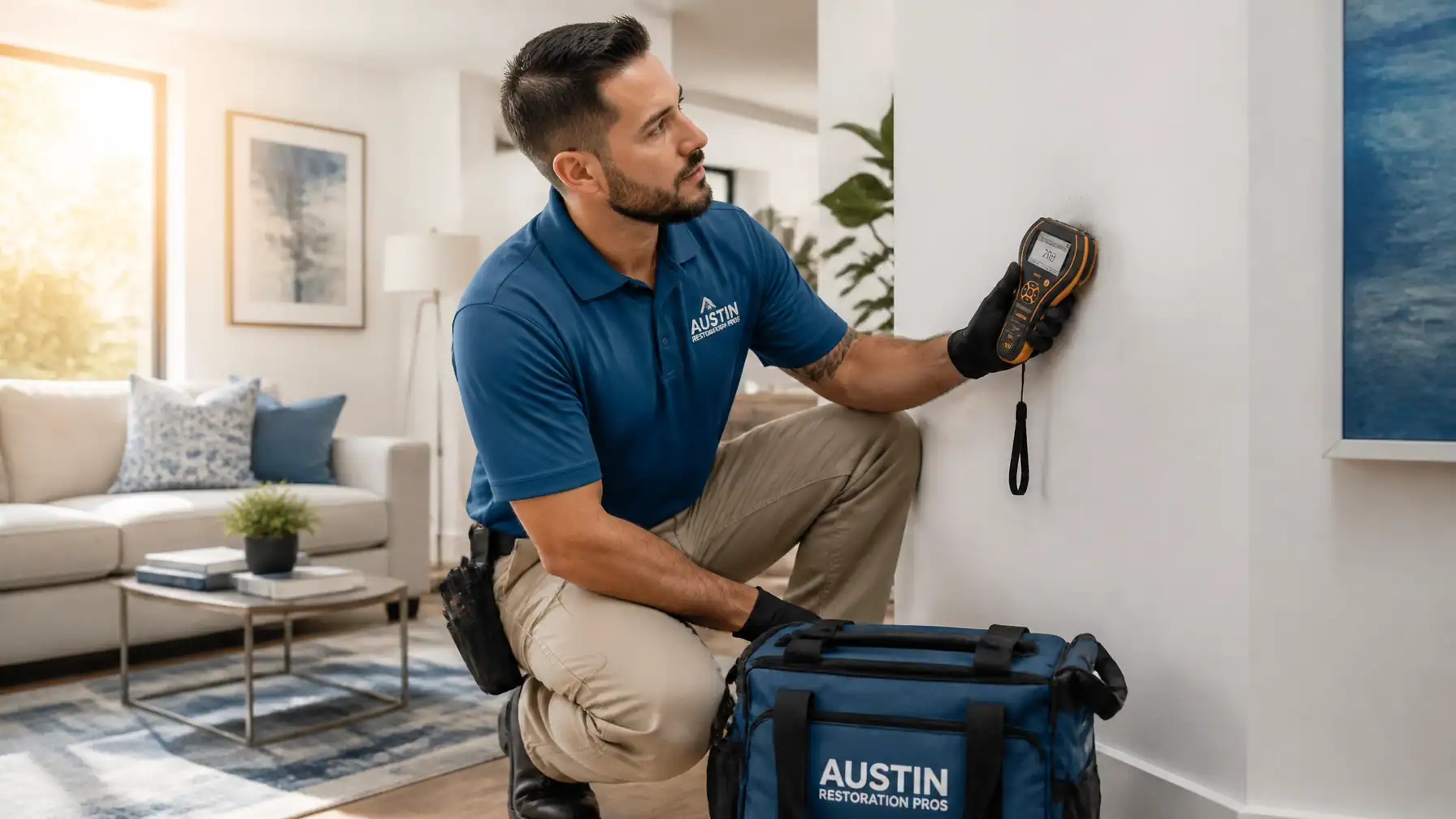

Finding mold in your home is never a "good" day. Whether it’s a fuzzy patch behind the guest bathroom toilet or a musty smell wafting from your HVAC vents after a humid Austin summer, the first question every homeowner asks is: "How much is this going to cost me?"
The internet will give you all sorts of ranges, from $500 to $30,000. But if you live in Central Texas, the "standard" numbers you see on national blogs often don't apply due to our specific state laws and climate.
As a licensed Austin restoration contractor, I’m here to give you the honest answers. This isn’t a sales pitch, it’s a look at the actual math, the legal requirements in Texas, and the things most companies won't tell you before you sign a contract.
What Does Mold Remediation Actually Cost in Austin?
In the Greater Austin area, a standard, professional mold remediation job typically starts between $6,000 and $8,000.
I know that might sound high if you were expecting a quick "spray and wipe" service, but there is a reason for this baseline. Every legitimate mold job requires the same core components regardless of the size of the patch:
- Containment Setup: Building airtight plastic barriers to prevent spores from floating into unaffected rooms.
- HEPA Equipment: Running air scrubbers and industrial dehumidifiers.
- Documentation: State-mandated paperwork and logging.
- Strict Remediation Protocols: Following the specific "playbook" required by Texas law.
- Dwell Time: Chemicals and treatments often require a 24-to-48-hour period to work effectively.
There is no such thing as a $500 mold remediation that follows Texas state guidelines. If someone quotes you that, ask them to show you the protocol. They are likely skipping the steps that actually keep your family safe. The final cost depends on the scope: how many rooms are affected, whether the source of moisture has been repaired, how saturated the materials are, and, most importantly, what's hiding behind your walls.

The Texas "Three Entities" Rule: It’s the Law
In Texas, we have some of the strictest mold regulations in the country. This is actually a win for you as a homeowner because it prevents "snake oil" salesmen from taking advantage of a bad situation.
By law, the company that inspects for mold and the company that removes it must be separate entities. You need three players on the field:
- Mold Assessment Consultant (MAC): This is a licensed third-party inspector. They collect samples, send them to a lab, and write the Remediation Protocol. They are legally forbidden from doing the removal themselves.
- Mold Remediation Contractor (MRC): That’s us at Best Option Restoration of Central Texas. We are the licensed company that performs the actual removal and treatment following the protocol written by the MAC.
- Independent Laboratory: They analyze the mold type and quantity and confirm whether the remediation was successful through "clearance testing."
If a company offers to "inspect and fix" the mold themselves for one flat fee, be careful. That is a conflict of interest and potentially illegal in the state of Texas.

Why Does Mold Come Back After Remediation?
We get calls all the time from frustrated homeowners saying, "I paid a guy to clean this six months ago, and it's already back!"
In nearly every case, the answer is the same: The source was not correctly repaired.
Think of mold as a symptom and the moisture as the disease. Mold is a living organism that needs food (your drywall or wood) and water to survive. If you scrub away the mold but leave a leaking pipe, a failing HVAC system, or high ambient humidity in your crawl space, the mold will return every single time.
At Best Option Restoration, we don't just "clean" mold; we help identify the water damage source so you don't have to pay for the same job twice.
Why Do Mold Remediation Quotes Vary So Much?
If you call three different companies in Austin, you might get three very different numbers. Here is why:
Some companies provide a low-ball "entry" quote but don't include the required "extras." Things like HVAC cleaning, plumbing repairs, or post-remediation clearance testing often appear as surprise add-ons later.
We believe in transparency. At Best Option Restoration of Central Texas, we separate every line item explicitly. You will see exactly what you are paying for, from the number of air scrubbers to the square footage of drywall being removed. No "mystery fees."

What to Do (and Not Do) Before the Inspector Arrives
If you’ve spotted mold, your actions in the first 24 hours can significantly impact the final cost of the job.
Do This:
- Identify the moisture source: If you can safely stop the leak, do it.
- Cover the area: If you see visible mold on a wall, tape a trash bag over it to limit the spores from spreading when the AC kicks on.
- Document everything: Take photos before you touch anything.
Do NOT Do This:
- Don't run fans: Do not point a fan at a moldy patch. You are essentially "seeding" your entire house with mold spores.
- Don't scrub it: Disturbing the material releases millions of spores into the air.
- Don't remove drywall yourself: Unless you have professional containment (plastic sheeting and negative air), you are likely cross-contaminating your home.
Is Mold Remediation Covered by Homeowners Insurance?
This is a tricky one. In Austin, "pure" mold coverage (meaning mold that grew slowly over time due to humidity) is typically capped at a very low amount, often between $5,000 and $10,000.
However, most mold damage in Austin is the result of a sudden water damage event, like a burst pipe or a water heater failure. In these cases, the mold is considered "secondary damage" to a covered water loss. This means the mold remediation is "stacked" on top of the water loss claim, which often provides much better coverage.
We work directly with insurance adjusters every day to ensure your claim is documented correctly so you get the coverage you're entitled to.
How Long Does Mold Remediation Take?
You should plan for the process to take about a week. Here is the typical timeline:
- Assessment and Containment (Day 1): The MAC writes the protocol, and we set up the air-tight barriers.
- Demo and Dry-Out (Days 2-4): We remove affected materials and run industrial drying equipment to get the "disease" (moisture) out of the home.
- Final Cleaning (Day 5): A minimum 24-hour "settling" period followed by HEPA vacuuming and antimicrobial wiping.
- Post-Remediation Testing (Days 6-8): The independent lab takes samples. Results usually take 24 to 96 hours.
Two Questions to Ask Before You Sign Anything
Before you hire any contractor in Austin for mold work, ask these two questions:
- "Do you require a protocol from a licensed MAC?" If they say no, they are breaking Texas law. Walk away.
- "Do you offer a warranty?" This is a trick question! Honest companies will actually say no. Mold is a living organism; we can't control your environment or your plumbing after we leave. If a company "guarantees" mold will never return, they are making a promise they can't legally or scientifically keep.
Should You Wait or Call Now?
Waiting makes it more expensive. Every day that moisture sits in your walls, the mold colony grows, and the structural integrity of your home weakens. As we like to say in the industry: "Your home cannot sense mold. It can only show it." By the time you see it, it's already been busy at work.
If you suspect you have a mold problem in Austin, Round Rock, or the surrounding areas, don't wait for it to become a $30,000 whole-house disaster. Give us a call at 512-883-8303. We’ll give you an honest assessment and a clear path to getting your home back to normal.