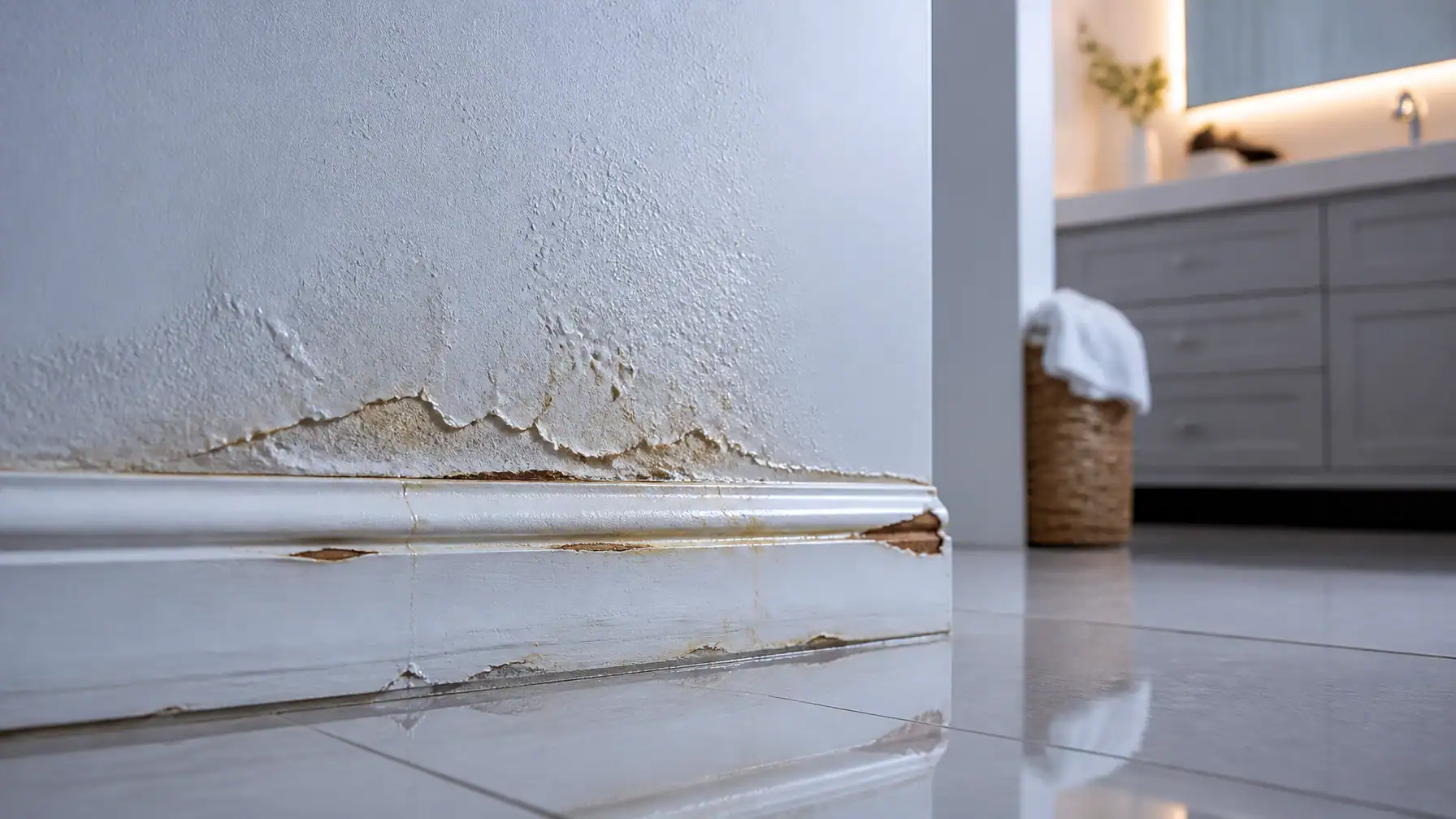

If you’ve ever walked into your bathroom and noticed a tiny bit of peeling paint on the baseboard or a strange "bubble" on the wall, your first instinct might be to ignore it. After all, bathrooms are wet places. Maybe it’s just humidity, right?
At Best Option Restoration of Central Texas, we see this every day. Homeowners call us thinking they have a minor cosmetic issue, only to find out that their bathroom baseboard water damage is actually the “tip of the iceberg.” Behind that small bubble or slightly swollen trim, a silent disaster is often unfolding.
By the time you see the damage on the outside, the party inside your walls has been going on for a while. Let’s dive into why you should never ignore these signs and how we use high-tech tools like thermal imaging to save your home from becoming a mold factory.
The "Tip of the Iceberg" Theory
Water is lazy, it always takes the path of least resistance. When a pipe leaks behind a wall, or a shower seal fails, the water doesn't stay in one spot. It travels. It runs down the back of the drywall, pools at the baseboard, and soaks into the wooden wall studs.
Because drywall is porous (like a sponge), it sucks that water upward. However, the outside of your wall is usually covered in semi-gloss or high-gloss paint, which acts as a vapor barrier. The water gets trapped between the wood/drywall and the paint.
This is why visible baseboard damage is so deceptive. You might see an inch of peeling paint, but behind the wall, there could be three feet of saturated insulation and wood rot.
Bubbles on the Wall: What’s Really Going On?
Have you noticed "bubbles" or blisters forming on your bathroom walls? This isn't just a bad paint job. When moisture is trapped inside the drywall, it turns into vapor as it tries to escape. Since it can’t get through the paint, it pushes the paint away from the wall, creating those characteristic bubbles.
If you pop one (please don't!), you’ll often find it’s damp inside or smells musty. This is a primary indicator of water damage restoration being needed immediately.

As shown in the image above, we don't just "guess" if a wall is wet. We use pinless moisture meters to get a scientific reading. If that number is high, we know that the "small" bubble on the surface is just the beginning of the problem.
The Science of Seeing Through Walls: Thermal Imaging
One of the most frequent questions we get at Best Option Restoration of Central Texas is, "How do you know where the water went without tearing down my whole bathroom?"
The answer is Thermal Imaging.

Water-damaged areas are typically cooler than the surrounding dry materials because of evaporation. By using infrared cameras, our technicians can "see" the moisture footprint behind your tiles, baseboards, and drywall. This allows us to be surgical. Instead of tearing out your entire bathroom, we can identify the exact 2-foot section that needs to be removed or dried. This saves you time, money, and a whole lot of headache.
Who to Call for Mold on the Ceiling?
Sometimes the water doesn't start at the floor. If you see dark spots or fuzzy growth on your bathroom ceiling, you likely have a leak from the roof, an attic pipe, or the bathroom upstairs.
When homeowners ask who to call for mold on the ceiling, the answer is a certified restoration professional: not just a handyman. Mold in a bathroom can spread through the HVAC system and affect your entire home's air quality.

At Best Option Restoration, we specialize in mold removal in Austin, TX. We don't just spray bleach on it (which actually doesn't work on porous surfaces); we use HEPA filtration, containment barriers, and professional-grade antimicrobial treatments to ensure the mold is gone for good.
Why Bathroom Baseboards Fail First
Most modern homes use MDF (Medium Density Fiberboard) for baseboards. While it looks great, MDF is essentially compressed sawdust and glue. When it gets wet, it acts like a sponge, expanding and "blistering."
Once MDF baseboards have swollen, they can rarely be "saved." They usually need to be replaced. However, the real work is drying the pipe leak or slab leak that caused the swelling in the first place.
The Professional Restoration Process
If you call us for bathroom baseboard water damage, here is what our process looks like:
- Inspection & Documentation: We use moisture meters and thermal imaging to map the damage. This is crucial for your insurance claim! (Check out our FAQ for Austin restoration for more on insurance).
- Source Identification: We make sure the leak is actually fixed.
- Controlled Demolition: We remove only what is necessary: typically the baseboards and a "flood cut" (removing the bottom portion of the drywall) to expose the wet studs.
- Structural Drying: We use industrial-strength air movers and LGR dehumidifiers to pull the moisture out of the wall framing.


Don't Wait Until the "Small" Leak Becomes a Big Problem
In the humid Austin climate, mold can begin to grow in as little as 24 to 48 hours. That little bubble on your wall today could be a full-blown mold remediation project by next week.
If you see bubbles on your wall, swollen baseboards, or mysterious stains, give us a call. We offer 24/7 emergency response across the Greater Austin area, including Round Rock, Cedar Park, and Georgetown.
Ready to get your home back to normal?
Call Best Option Restoration of Central Texas today at 512-399-0481. We’ll bring the high-tech tools and the local expertise to make sure your "small" leak doesn't change your life for the worse.