You kicked the mold out. The air scrubbers hummed like a spaceship. The plastic sheeting made your living room look like a quarantine movie set. Now what? You do not guess that your home is safe. You prove it. That next step is called post-remediation verification, also known as mold clearance testing. It is the independent check that confirms the treated area is clean, dry, and ready for normal life again. Skip it, and you risk sealing problems inside your walls like a time capsule of trouble. Do it right, and you can confidently move forward with repairs without wondering what is still lurking.
What Is Post-Remediation Verification?
Post-remediation verification, or PRV, is the inspection and testing phase that happens after mold remediation is complete and before any reconstruction. Its job is simple: verify that the work zone is clean, the moisture source is fixed, materials are dry, and the air and surfaces no longer show elevated mold contamination.
PRV typically includes four pillars: a detailed visual inspection, moisture testing, air sampling, and surface sampling. Then the findings go into a written report with lab results, photos, methods, and chain-of-custody records. The goal is to confirm you did not just remove the visible mold but also removed settled spores, dust, and hidden moisture that would let mold rebound like a bad sequel.
Professionals lean on established references when they perform PRV. You will hear about IICRC S520, which is the widely accepted standard for professional mold remediation. Assessors also reference guidance from AIHA and ASTM for sampling and data interpretation. In Texas, you have regulated licensing for assessors and remediators, and they cannot be the same company on the same project. That separation helps ensure the clearance check is an actual check, not a pat on the back.
What Happens During Clearance Testing
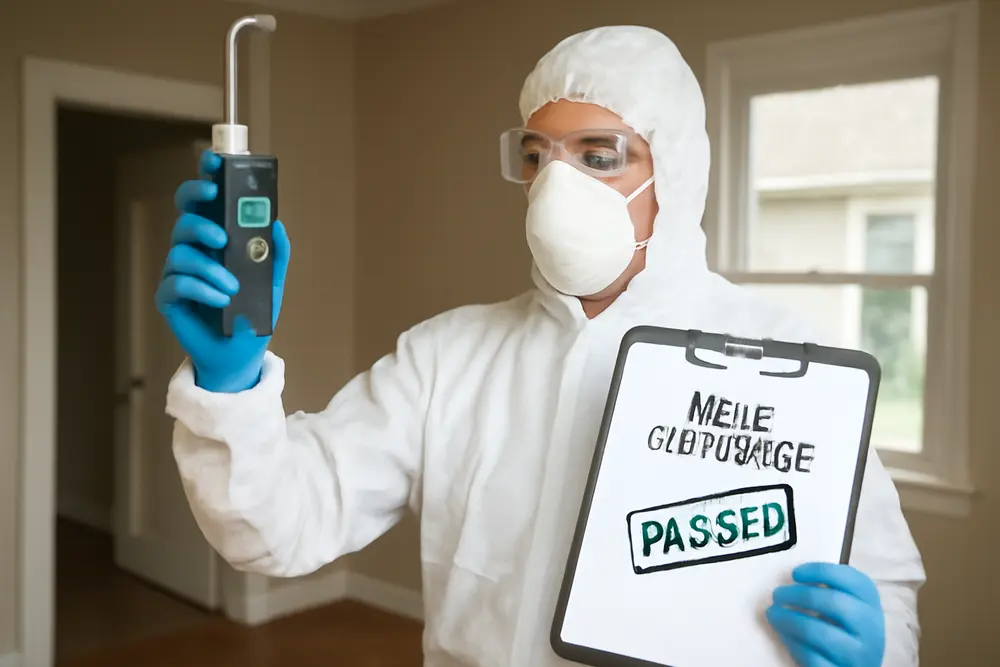
Let us peel back the curtain on what a real PRV session looks like. First, the assessor shows up with meters, sampling cassettes, wipes or tape lifts, PPE, and an annoyingly sharp eye for dust you thought you cleaned. They review the work area while containment and negative air machines are still active or at least still set up. If the space looks like a construction zone with debris on the floor and a musty whiff, testing pauses so cleaning can continue. A pass never starts with a mess.
Visual inspection comes first. All visible mold growth must be gone. No fuzzy patches, no shadowy stains that smear when wiped, no blackened paper on drywall, no green freckles on framing. Surfaces should be visibly clean, including ledges, sill plates, and the tops of ductwork or trim. The assessor checks the perimeter of containment, adjacent rooms, and HVAC supply or returns for cross-contamination. If there is settled dust inside the work zone, you are not ready to sample. Dust acts like a bus for spores and fragments, and clearance criteria hate buses.
Moisture evaluation follows. Mold is a moisture problem first, then a mold problem. The assessor uses pin or pinless meters and sometimes thermal cameras to verify materials are back to normal dry conditions. Dry is relative to unaffected control areas and to material benchmarks. If you are in Austin in August and the outdoor humidity laughs at your dehumidifier, a pro still expects interior materials to measure within acceptable ranges. If a wall cavity or subfloor is still wet, sampling waits. Otherwise you are testing a damp space that can re-colonize before the paint dries.
Air sampling is the next move. Commonly, spore trap cassettes collect a ten-liter-per-minute air sample for a set time, pulling airborne particles onto a sticky trace. There is always an outdoor sample to set a baseline for what is floating in the local air at that moment. The assessor then collects samples inside the treated area, and sometimes in adjacent unaffected rooms. The lab counts and identifies spores to the genus or group level, then reports concentrations per cubic meter. The goal is not zero spores. The goal is consistent with, or lower than, outdoor levels, with a profile that makes sense for indoors. That means indoor counts should not be loaded with water-damage indicators when the outside air is calm and boring.
Surface sampling rounds it out. Tape lifts or sterile swabs target those hard-to-clean spots like the underside of a sill plate, the back of a cabinet, or the top of a joist. On porous materials that were cleaned rather than removed, surface samples can confirm that staining is just staining, not active mold growth. If surfaces shed visible debris onto a clean wipe, the space needs another pass with HEPA vacuuming and damp wiping before anyone talks about passing.
Finally, documentation. Every legitimate PRV comes with a report that shows sampling locations, indoor and outdoor conditions, photos of the work area, moisture readings with meters named, calibration dates, lab accreditation, and a chain-of-custody from the field to the microscope. If your report does not tell a detailed story, you are missing the proof that your home is actually ready for rebuild.
Pass Criteria: Did You Pass?
Different assessors state criteria in slightly different ways, but the core looks very similar across the industry. You pass when the treated area is visibly clean, dry per meter readings, and testing no longer shows evidence of elevated or atypical mold for an indoor environment. Here is a quick snapshot of what that actually means in the real world:
| Category | Passing Example | Failing Example |
|---|---|---|
| Visual Condition | No visible growth, no dust film, no debris; surfaces look clean to the eye and wipe clean | Specks of growth on framing, film of dust on sheathing, demolition debris left in corners |
| Moisture Readings | Similar to unaffected areas and below target thresholds for that material | Elevated moisture in framing, subfloor, or drywall; cold, damp cavities on thermal camera |
| Air Samples | Total spore counts equal to or lower than outdoor baseline with no significant elevation of water-damage indicators | Indoor counts higher than outdoor, heavy presence of Penicillium/Aspergillus-type spores or Chaetomium/Stachybotrys inside |
| Surface Samples | Negligible or no spores detected on cleaned structural surfaces | Active-looking structures or abundant spores on cleaned surfaces |
| Zero-Tolerance Species | No detection of certain toxigenic water-damage molds in the work zone | Any detection of Stachybotrys or Fusarium on a treated surface can trigger a fail |
There is nuance here. A windy Austin day might shove outdoor spore counts sky high. Indoors may still pass if the profile and proportions make sense and the treated area is not elevated relative to outside. On the flip side, a quiet outdoor baseline with a moldy indoor profile is a clear fail even if the numbers do not look dramatic on paper. This is why you hire a pro who knows how to interpret data in context, not just point at numbers.
If You Fail, What Next?
Failure is feedback. It tells you what still needs attention. A real PRV report spells out the why. Maybe there is residual dust and spores on the sheathing. Maybe an inaccessible cavity is still wet. Maybe containment leaked and cross-contaminated a hallway. Or maybe the remediation plan missed a hidden source behind cabinets or under a tub. Each cause has a fix, and the fix is not guesswork.
The remediation contractor goes back in while containment is still up. HEPA vacuuming, damp wiping with appropriate cleaning agents, and targeted removal of stubborn materials might be on the list. If moisture is the culprit, the drying plan gets extended and re-aimed with focused airflow, dehumidification, or even temporary removal of baseboards to open up wall-to-floor joints. If sampling shows a pressure imbalance or containment breach, the negative air setup and make-up air path get corrected so you are not dragging dust from dirty to clean zones.
Then you retest. PRV is not a one-and-done if conditions are not right. You do not tear down containment or start hanging new drywall until the clearance criteria are met. An extra day of drying or cleaning is cheaper than a second remediation project after your new cabinets are in.
Austin And Texas Rules You Need To Know
Texas regulates mold assessment and remediation through the Texas Department of Licensing and Regulation, also known as TDLR. In plain English: the person or company who writes your mold assessment and clearance plan must be licensed, and the person or company who performs remediation must be licensed. Those roles cannot be the same entity on the same project. That firewall is there to prevent conflict of interest and to keep your clearance testing independent.
Texas also uses a Certificate of Mold Damage Remediation, often called an MDR-1. When you work with licensed pros and the job is completed according to the plan, you can request this certificate. It documents that the mold issue was addressed and that the underlying moisture problem was corrected. Lenders, insurers, and real estate transactions in Austin and across Texas often ask for this certificate because it gives a clear paper trail.
Timing matters. In Austin, PRV should happen after visible mold removal and drying are complete but before you rebuild. Do not insulate, drywall, or refinish until you pass clearance. If you close up walls and then fail testing, you are opening those walls back up again, and we both know that is a budget and schedule killer.
Who Should Do PRV?
An independent Indoor Environmental Professional or licensed mold assessment consultant should handle PRV. Independent means they are not the remediation contractor on your project. It avoids the we-graded-our-own-test problem. Make sure the lab they use is accredited, like AIHA-LAP, and that their report includes a proper chain-of-custody. Ask for a sample report before you hire. If it reads like a fortune cookie, keep shopping.
How To Choose A Tester
Start with credentials. In Texas, you want a TDLR-licensed mold assessment consultant or company for assessment and clearance activities. Look for real field experience with structures like yours, whether that is a 1920s bungalow in Hyde Park, a South Austin condo, or a hill country ranch with crawlspaces that bite back. Ask how many samples they plan to take and why. A minimal set usually includes one outdoor air sample and at least two indoor air samples in the treated area. Larger or more complex jobs need more, not less.
Ask how they define pass and fail. Good assessors can explain in plain language. Ask if they include moisture mapping, not just sampling. Sampling a wet wall and expecting a pass is like giving a treadmill stress test to a sprained ankle. It is the wrong sequence. Finally, ask about turnaround time. Many labs return results within 24 to 48 hours, but that depends on shipping and lab load. If you are trying to keep a contractor schedule moving, plan for a window rather than betting everything on a single day.
What You Can Expect In The Report
Your clearance report should not be a mystery novella. It should lay out the plan, the methods, the measurements, and the results clearly. Expect to see these pieces stitched together cleanly:
There is a narrative describing the work area, the remediation scope, and the conditions during inspection. There are photos that show containment, cleaned framing, and any noted concerns. Moisture readings are listed with meter type and material. Air and surface sample locations are mapped or at least described by room and height. Lab results identify spores by category with actual counts or ranges per cubic meter for air and per area for surfaces. The interpretation section then compares indoor results to the outdoor baseline and to unaffected indoor areas when applicable. Finally, there is a verdict: pass or fail, with reasons and next steps if you failed any element.
Common PRV Pitfalls To Avoid
Mold clearance testing fails for a handful of predictable reasons. The big one is cleaning light. Post-remediation cleaning is not the same as straightening up. You need methodical HEPA vacuuming and damp wiping of all surfaces inside containment, top to bottom, followed by a settling period and then a second round if dust is still present. Another common pitfall is rushing the drying plan. Lumber and subflooring can look dry and still hold elevated moisture a quarter inch in. If you shut down dehumidifiers too soon, spores will thank you later by germinating right through your fresh paint.
Containment shortcuts also tank clearances. Gaps at the floor, leaky zipper doors, or unbalanced pressure can let dust and spores migrate. Proper negative pressure with a measured pressure differential and a controlled make-up air path helps keep clean zones clean. Finally, ignoring nearby spaces bites homeowners all the time. If the remediation area was the bathroom but the hallway HVAC return was open for months, you test the hallway too. Cross-contamination does not respect room boundaries.
Will Every Project Need Surface And Air Samples?
Some projects are simple enough that a qualified pro might skip certain samples if the area is small, containment was tight, and the visual and moisture lines look great. That said, most residential PRVs include at least one outdoor air sample, multiple indoor air samples in the treated area, and targeted surface samples where removal rather than replacement occurred. When materials were removed to a clean line and everything else is brand new, surface samples may be fewer because there are fewer suspect surfaces left. Your assessor should tailor a sampling plan to the risk profile, not just follow a script.
What About Odor?
Odor is not a lab result, but it is a signal. A musty smell after remediation often means something is still damp or something got missed. If the space smells off, many assessors will wait to sample and ask the remediator to revisit cleaning and drying first. Deodorizers and fragrances do not count as fixes. If you would not want a kid licking that surface, it is not clean enough. Yes, that is a blunt metric, and yes, it tracks remarkably well with clearance results.
When To Schedule Clearance
Plan PRV when the following are true: demolition and removal are complete, post-remediation cleaning is finished, drying equipment has run long enough to bring materials to target moisture, and containment is still intact with negative pressure running or at least ready to run again. Schedule early with your assessor so there is no dead space in your calendar. If results typically take 24 to 48 hours, coordinate with your contractor so reconstruction starts after the pass, not before.
Mold Clearance FAQs
Is PRV Legally Required In Texas?
Many residential projects are not legally required to have PRV by statute, but lenders, insurers, property managers, or real estate contracts often require it. When you are working with licensed assessment and remediation in Texas, PRV is the standard way to demonstrate the project reached the intended endpoint. Without a pass and proper paperwork, you may struggle to document that the issue was resolved.
Can My Remediator Do Their Own Clearance Testing?
They should not on your project. Texas separates assessment and remediation licenses to avoid conflicts of interest. Your clearance testing should be performed by an independent assessor or consultant who did not perform the remediation. That separation protects you and protects the integrity of the results.
How Long Do Lab Results Take?
Most spore trap and surface sample results return in 24 to 48 hours from a competent lab once the samples are delivered. Add transit time if the assessor ships samples out of town. Some labs in Texas offer rush options for a fee. Ask your assessor what timeline they expect before you book reconstruction crews.
What If Only One Sample Fails?
One failed sample can still be a fail for the project, especially if that sample shows a zero-tolerance mold in the work zone or a strong indicator of indoor growth. The fix might be surgical, like recleaning one bay of framing or extending drying in one wall cavity, but the clearance standard applies across the treated area.
Do I Need A Certificate Of Mold Damage Remediation?
If you are in Texas, you can request a Certificate of Mold Damage Remediation when licensed professionals complete the job in compliance with TDLR rules. Many insurers and real estate stakeholders value this certificate because it confirms that remediation occurred and that the moisture source was corrected.
What Does Passing Mean For Rebuild?
Passing means you can remove containment and proceed with insulation, drywall, cabinets, and finishes in the treated area. It also means your contractor, adjuster, or property manager has the documentation to keep the project moving. Keep a copy of the report and share it with anyone who needs to sign off on the next phase.
How Many Samples Are Enough?
Enough to characterize the work zone and any adjacent risk areas. That typically means one outdoor air sample and at least two indoor air samples in the treated area for small projects, with more for larger or multi-room jobs. Surface samples target cleaned structural members and hard-to-reach spots. A good assessor explains the plan before sampling, not after the invoice.
What To Do Before Your PRV Day
Get your space PRV-ready. Ask your remediator to perform final HEPA vacuuming and damp wiping on all surfaces inside containment. Confirm that dehumidifiers and air movers ran until moisture targets are hit, then allow a short settling period so air samples are not just counting dust you stirred up five minutes ago. Make sure containment is intact and under negative pressure. If your HVAC was part of the work zone, keep registers closed or covered as directed so you are not recirculating dust during sampling. Clear clutter so the assessor can access corners and cavities without playing obstacle course.
Clearance Testing And Your Health
PRV is not a medical test, but it does reduce risk. Elevated indoor mold can trigger symptoms in sensitive people, and even hardy folks do not need hidden moisture behind their walls. Clearance testing lowers the chance that you will re-expose your family by rebuilding over a problem. It also flags conditions that let mold grow in the first place, like chronic humidity, leaks, or condensation. Fix the water, fix the airflow, and keep surfaces clean. That trio will do more for your home than any single test ever could.
The Bottom Line On Passing
Mold clearance testing is the checkpoint between demolition dust and fresh paint. You pass when the space is clean to the eye, dry to the meter, and normal to the microscope. You fail when any of those disagree. In Austin and across Texas, keep your assessment and remediation roles separate by law, keep your documentation tight, and keep containment up until you have the pass in writing. It is not glamorous, but it is the difference between fixing a problem and wallpapering over it.